
HAYLOW Labs helps mentoring, youth, and community programs build systems for delivery, documentation, and proof — so the work becomes evidence, not just effort.
Most programs are better than they can prove.
The distance between the work your program does and what an outsider can see, verify, and trust is the proof gap. Closing it is what HAYLOW does.
Signal is a four-question read on your program's operational footing — onboarding, documentation, reporting, and quality measurement. Thirty seconds, no email required. You get a plain assessment and the one place to start.
The consultation is a direct, one-on-one call. We look at how your program actually runs — onboarding, records, reporting, quality — and scope the next concrete move. No pitch deck, no generic playbook. A custom read on your program and what to fix first.
Run Signal, or come with the problem you already feel. Either way we start from your program, not a template.
We find the weakest layer, name what it is costing you, and decide the one change worth making first.
You leave with a clear next step you can act on — and a sense of whether deeper, ongoing work makes sense.
For the director who can feel the sessions land — and can't yet show it.
Look inside
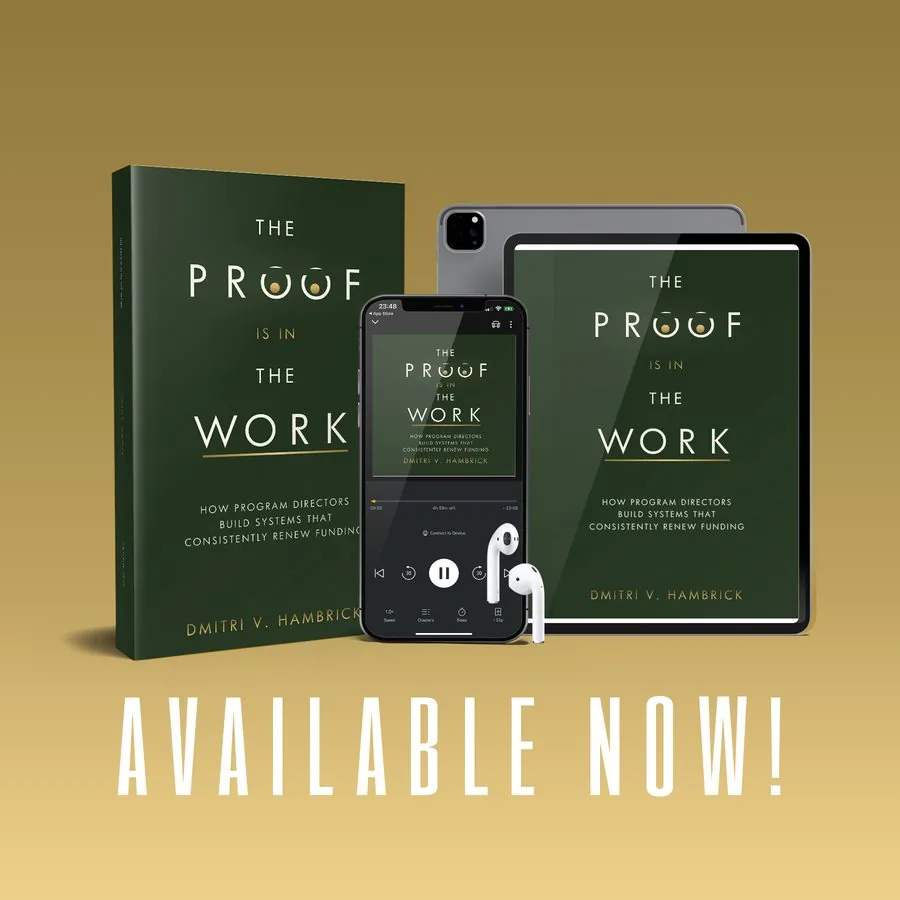
Every day, dedicated program directors watch funding go to weaker programs that simply describe themselves better. The difference is not heart, talent, or mission — it is proof. The Proof Is In The Work is the step-by-step guide to building a proof system: rubric, record, review, report. Written for the director who needs something more honest than a pitch and more practical than a framework.
Invisible excellence loses to visible competence every time.
Thirteen chapters across five parts: mindset, leadership, the operational core that turns sessions into evidence, the external case for funders, and a plan you start Monday.
By Dmitri V. Hambrick, founder of HAYLOW Labs — written from inside the programs most consultants only study. Read it before, alongside, or instead of a consultation.
Practical, no-fluff guides for program directors. Each one is built to be read in a sitting and used the same week.
Outputs vs. outcomes, what actually counts as evidence, and a four-part system that turns everyday sessions into proof a funder can read.
Read the guideThe plain-English version of the thing you keep getting told you need — a one-page theory of change you can write in an afternoon, and the outcomes it hands you to prove.
Read the guideA two-minute-per-session habit that turns what happened in the room into a record you can stand behind months later — without turning coaches into clerks.
Read the guideA section-by-section breakdown of what funders actually read — outcomes against your goals, the evidence behind them, and what to leave out.
Read the guideOutputs vs. outcomes vs. indicators, what to actually track, and how to capture relational change without flattening it into a number.
Read the guideThe lowest layer of the proof system: train every coach to one standard, so quality stops being a coin flip and every later layer can be trusted.
Read the guideWhat a rubric is, what belongs in it, and how to weight categories so a score actually reflects whether the session was good.
Read the guideYou could track a hundred things. Funders care about maybe six. The short list that actually proves impact — and the vanity metrics to stop counting.
Read the guideA renewal is not a new pitch — it is proof you did what you said. How to show delivery against last cycle's goals, own what missed, and make the case for the next one.
Read the guideThe book
Opens Amazon in a new tab — you won't lose your place here.
Every day, dedicated program directors watch funding go to weaker programs that simply describe themselves better. The difference is not heart, talent, or mission — it is proof.
The Proof Is In The Work is the step-by-step guide to building a proof system: the rubric that defines what good looks like, the record that captures what happens, the review that turns both into evidence funders can verify, and the report that makes the case. Written for the director who needs something more honest than a pitch and more practical than a framework.
Inside the book